From Archaic Myth to Digital Prestidigitation: The Concept of Enlightenment
Updated: Oct 22, 2025
The Concept of Enlightenment
Far from being a crystallized answer, it is a field of philosophical tension. Although its historical peak was in the 18th century, with its cry for the autonomy of reason (as the philosophical-political project of the Enlightenment), thinkers like Adorno and Horkheimer show us that its fundamental impulse – the domination of nature through knowledge – is an archetypal and ambivalent force of the human condition, like a fundamental anthropological process that began at the dawn of humanity.
The Enlightenment project, therefore, did not invent but radicalized a dynamic inherent to our species.
However, this same reason that claimed to be emancipatory proved to be mutable, capable of bending to new ends. Thus, the abstract ideal of "thinking for oneself" descended into the concrete world: it shaped educational systems, justified revolutions, inspired human rights, but also generated impersonal bureaucracies, science without conscience, and increasingly refined techniques of social control.
The concept of Enlightenment, therefore, does not describe a monument of the past, but a living—and ambivalent—force that still structures and tensions our experience in the world today.
Thus, from the archaic myth that explained the world through gods, passing through the theological prestidigitation of the Middle Ages, the humanist reason of the Renaissance, and the faith in progress of solid modernity, until flowing into the liquid modernity of algorithms—which know us better than we know ourselves—cultural studies converge on a diagnosis: the Enlightenment was not overcome, but revealed itself to be a deeply adaptable and mutating force.
Its essence can be methodologically traced as an invisible structure that persists under new guises, an operating code that, from generation to generation, continues to organize, hierarchize, and give meaning—sometimes contradictory—to our social relations: from the most intimate to the most collective.
What is a Myth: The First World-Explaining Machine (The Embryo of Enlightenment)

Imagine myth as humanity's oldest operating system. Before science, philosophy, or history, myths were the 'software' that humans used to 'run' reality. Their function was not entertainment; it was pure cognitive and social survival.
The Primary Function of Myth (Taming Chaos)
The world is, by nature, a frightening place: thunder, disease, death, the drought that destroys crops, famine. Chaos and the unpredictable generate paralyzing fear.
Thunder is no longer a terrifying noise from nowhere. It is Zeus throwing his lightning bolts because he is angry. Winter and the death of plants is no longer a random and tragic event. It is the story of Persephone, who spends half the year in the underworld, and her mother, Demeter, mourns, making the earth barren.
The Creation of the World is not a cosmic accident. It is a succession of gods and titans, as in Hesiod, who struggle and give rise to reality.
The Mechanism: The Logic of Myth
Here is the genius (and the trap) of myth: It does not explain by the "laws of physics," but by the "laws of drama." Scientific causality (cause and effect) is replaced by narrative causality (revenge, love, punishment, gift).
It humanizes the universe. The gods get jealous, love, betray, get angry. It is a projection of the human psyche onto the cosmos.
Myth emerges as a tool of primitive enlightenment. Its mission is: To transform frightening Chaos into ordered Cosmos. To give a NAME and a STORY to what was inexplicable.
Myth, far from being a simple fable or a primitive mistake, is one of the most fundamental tools for the transmission of culture and tradition.
Through symbolic narratives and the common sense it itself generates, myth encapsulates values, explains origins, and guides behavior in an intuitive and accessible way, making the complex social fabric understandable.
Important: The problem, therefore, never resided in the myth itself – a neutral and potent structure of meaning –, but in the function assigned to it and how it is instrumentalized.
When myth closes itself off to questioning, crystallizes oppressive hierarchies, or is used to mask power relations under a veil of inevitability, its pedagogical nature corrupts into dogmatism.
Thus, the fine line between wisdom and domination is not in the existence of myth, but in the intention with which it is activated and the freedom it offers – or denies – to criticism.
The Price of Order (Fatalism)
By taming chaos, myth imposes a rigid order. And that's where the problem lies. If the drought is a punishment from the gods, the solution is not irrigation or soil science, but sacrifice rituals and prayers.
If your destiny is written by the gods (the Greek "fate"), like that of Oedipus, then human freedom is an illusion.
Myth creates a closed and cyclical world. The same stories repeat themselves, fate is immutable. There is no room for progress or revolution, only for submission to the established (divine and, consequently, social) order.
The Big Secret: Myth and Enlightenment are Relatives
This is the central point revealed by Horkheimer and Adorno: Myth is already a rudimentary form of Enlightenment, and modern Enlightenment has become a new type of Myth.
Myth wants to enlighten (remove fear by giving an explanation).
Enlightenment wants to dominate (remove fear through total control).
In the end, both seek the same thing: to eliminate the unknown. The difference is the method. Myth uses stories and magic. Enlightenment uses numbers and laws. But when reason becomes a tool of blind domination ("instrumental reason"), it becomes a new myth — a myth even more powerful and dangerous, because it disguises itself as "objectivity" and "progress."
In a Nutshell
A myth is not a childish "lie." It is humanity's original system of explanation, which uses dramatic narratives to transform a chaotic and frightening world into an ordered and meaningful cosmos.
Its function is to tame the fear of the unknown.
The price it charges is submission to a rigid and fatalistic order. And, in the end, modern science, in its quest to dominate nature, repeated this same structure, becoming a "technological myth" as merciless as the ancient ones.
Digital Prestidigitation: The Thread of Illusion from Antiquity to the Algorithm
Imagine an invisible thread weaving the history of power. This thread is Prestidigitation – the art of manipulating perception to create illusion. Its color and purpose change with the eras, but its material – the human psyche – is the same.
The Dialectic of Enlightenment: The Myth of the Hero Who Became a Monster
Imagine the Enlightenment (Reason, Science, Progress) as an epic hero. Its mission was noble: to free humanity from fear. Fear of angry gods, fear of frightening nature, fear of inexplicable myths.
THE HEROIC MISSION (Liberate through Knowledge)
To fulfill its mission, the hero "Enlightenment" declared war on everything that was mysterious. Its motto was: "Nothing should be mysterious and uncontrollable. Everything can and should be explained, measured, and dominated."
It attacked ancient myths, calling them "superstitions." It desacralized nature, transforming it from a living and fearsome "mother" into a simple "object" to be studied and exploited.
Its main weapon was instrumental reason: the idea that thought is a tool (an instrument) to calculate, predict, and, above all, dominate.
THE GREAT BLOW: The Hero Uses the Enemy's Weapons
Here is the first "click" of the dialectic. Horkheimer and Adorno show that, to defeat Myth, Enlightenment ended up becoming the very thing it wanted to destroy.
Ancient myths were already a primitive attempt to enlighten the world. The myth of thunder, for example, tries to explain a frightening natural phenomenon. It gives a name and a story to what was chaotic.
By fighting against myth, Enlightenment did not abandon the structure of myth; it merely created a new type of myth: the Myth of Totalitarian Reason.
The "Fate" and "Destiny" of ancient myths were replaced by the "Laws of History," "Laws of Economics," and "Laws of Science" — systems as merciless and unquestionable as the gods they replaced.
THE FALL (The Hero Becomes Corrupt)
The hero, in its obsessive quest for control, begins to apply its logic of domination not only to nature, but to everything and everyone.
Domination of Nature:
Nature becomes a resource.
Forests are not sacred, they are "stored wood."
Rivers are not deities, they are "hydroelectric potential."
Domination of Human Beings:
If nature is an object, people can be too.
Society becomes a "machine."
Individuals become "human resources."
Instrumental reason calculates the efficiency of a concentration camp with the same coldness with which it calculates the efficiency of a factory (Foucault).
Self-Domination: Finally, we internalize this logic. We repress our emotions, our desires, our intuition—everything that is "irrational" and "uncontrollable"—to become purely rational, efficient, and predictable beings. We become robots of ourselves.
THE FINAL PARADOX (The Dialectic)
Here is the key turn, the final "click":
The Enlightenment, which was born to liberate men from the fear of the unknown, ended up creating a new and more terrifying prison: a totally administered, controlled, and meaningless world, which generates a new barbarism.
The attempt to exterminate myth resulted in the return of myth in the form of a blind and totalitarian reason. The hero, in its fight against the monster, stared into the abyss for so long that it itself became the monster.
In a Nutshell
The Dialectic of Enlightenment is the idea that reason (the "Enlightenment"), when used only as a tool of domination and control ("instrumental reason"), turns against humanity itself.
It frees us from ancient myths, but ends up creating a new myth, even more dangerous: the myth that everything (nature, society, people) is just a number, an object, a resource to be exploited. In the end, this blind quest for control leads us back to barbarism, only now with state-of-the-art technology.
It is the philosophical explanation for why the 20th century, the most "enlightened" in history, was also the century of extermination camps and atomic bombs.
The brightest light can cast the darkest shadows.

The history of the Enlightenment can be visualized in 3 acts, to facilitate our understanding.
ACT 1: Sacred Prestidigitation (The Sorcerer-Shaman)

In Antiquity, prestidigitation was the technology of the sacred.
The Shaman who "removed" a stone from a sick person's body (using sleight of hand) was not a charlatan. He was a healer. His illusion was a powerful placebo, an act of therapeutic prestidigitation that reinforced the tribe's belief and the authority of the spiritual leader.
The Egyptian priests who "opened the temple doors with a gesture" (activating hidden mechanisms) used prestidigitation to produce awe and faith. The illusion was the fuel of Myth, the visible proof of an invisible power.
Their pact was one of authority: The audience did not consent to be deceived; they submitted to the illusion as a manifestation of the divine.
ACT 2: Prestidigitation-Art-Spectacle (The Stage Magician, emergence of Cinema and Broadcast)

With the Enlightenment, prestidigitation migrated from temples to theaters and new forms of spectacle, like cinema. It was desacralized.
Figures like Robert-Houdin and Émile Reynaud did not sell miracles. They sold wonder. The trick of the top hat or the Théâtre Optique was a celebration of human skill, of mechanical ingenuity.
It was instrumental reason in the service of playful astonishment. The audience paid to see technique (the "how") triumph, in a pact of pure consent: "I know it's a trick, and I love it!"
This was the brief and brilliant moment when prestidigitation was PURE LIGHT, before the great capture.
ACT 3: Digital Prestidigitation (The Algorithm-Sorcerer)
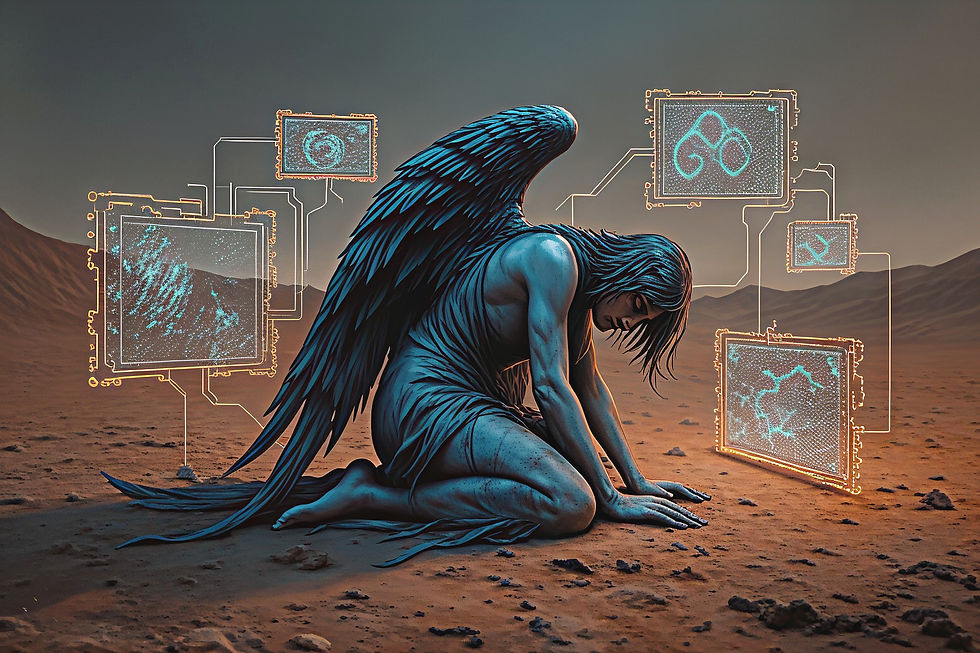
And then, the system awoke. The same logic of domination of the Enlightenment – reason as a tool of control – identified in prestidigitation the ultimate weapon.
Digital prestidigitation is the return of Myth, but now with highly scalable potential and the coldness of science.
The Ancient Shaman became the Feed Algorithm. It does not heal bodies, but controls behaviors. It knows your fears and desires better than you do, and "pulls" from your pocket not a rabbit, but a hyper-personalized ad, a news story that confirms your anger, a simulation of reality.
The Temple Priest became the Digital Coach Guru. He does not operate hidden mechanisms in stone doors, but leverages the same cognitive biases that the magician uses.
He sells the illusion of instant personal transformation, the "magic trick" for success, exploiting the same willingness to believe that the ancient pilgrim had.
The Pact of Consent was broken. You don't pay for a ticket to the show. You are the product in the show. The illusion is no longer to marvel, but to keep you engaged, consuming, and, above all, predictable.
From this inaugural moment, prestidigitation crossed the 20th century shaping perceptions through the media. Cinema transformed illusion into a totalizing narrative, blending technique and myth. Radio carried this enchanting voice to every corner, while television consecrated the spectacle as a domestic routine.
With each new medium, prestidigitation refined itself, disguised in new formats. In the digital environment, however, the multiplication is exponential: it is no longer a single trick, but millions of invisible tricks embedded in algorithms, interfaces, and data flows.
Every click, every scroll, every notification is a small, calculated magic trick to capture attention, naturalizing enchantment on an industrial scale.
THE FINAL PARADOX: The Circle Closes
Digital prestidigitation is the monstrous fusion of Myth and Enlightenment.
It uses the most enlightened tool that exists – data science, cognitive psychology – to create the most efficient and personalized mythological system in history.
Like Ancient Myth, it offers simple explanations for complex fears (the "political enemy X" is the cause of all your problems).
Like Corrupted Enlightenment, it reduces you to a set of manipulable data, a "resource" to be optimized for engagement.
The Thrush (genuineness, pure art) is silenced by the amplified squawk of the Graduated Vulture (the platform, the algorithm, the guru), which dominates the digital "land."
In a Nutshell (Pocket Summary)
Prestidigitation is the art of creating illusion. It began as a technology of sacred power (the Shaman), briefly became a pure art of wonder (the Magician), and today has been captured to become the central cog of digital power (the Algorithm).
"Digital prestidigitation" is the non-consensual use of the magician's techniques – the manipulation of perception – by the logic of domination of the Enlightenment, creating a new totalitarian, personalized, and real-time myth.
And so, the trilogy is complete: from the Myth that wanted to explain, to the Enlightenment that wanted to dominate, to the Digital Prestidigitation that is the malignant synthesis of both.
We have reached the end of this first trail, but not the limit of the investigation. Each article in this series has been grounded in rigorous theoretical and scientific backing—from Freudian psychoanalysis to critical philosophy, from anthropology to technology theory—because we believe that profound ideas require solid foundations.
If there is one axis that guided this journey, it was the understanding of the fundamental dialectical relationship between Culture and Technology: the former, the realm of the abstract, of meaning and the symbolic; the latter, the force of its concrete materialization in the world.
This productive tension, the root of the very theory of perception in the arts, is the engine that drives both an ancestral ritual and a feed algorithm.
This was not an exercise in opinion, but a methodical effort to map the invisible structures that shape our experience.
May this set of conceptual tools not be an endpoint, but a compass for our own discoveries. The journey of thought, when well guided, is just beginning.
This topic is found in the book Dialectic of Enlightenment, Adorno and Horkheimer, 1948.


Comments